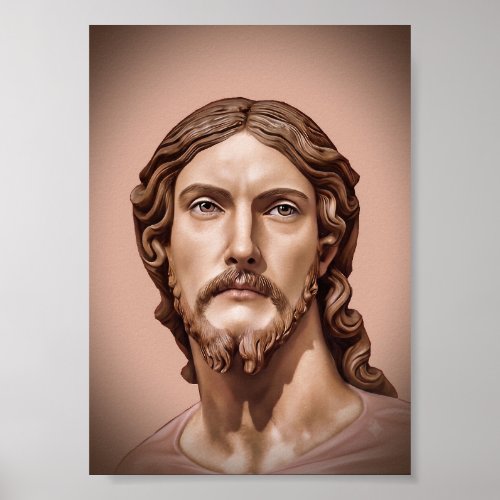
BUST OF CHRIST THE SAVIOR by MICHELANGELO 2026__ Poster
by markewesterfield
BUST OF CHRIST THE SAVIOR by MICHELANGELO 2026__ computer soft watercolor effect
or CHRIST THE SAVIOUR
Computer colorized by Mark Edward Westerfield 2026 (rose D8AC99)
or (maroon 661506).
Computer colorization by Mark Edward Westerfield 2026 (July 19)
Lost Michelangelo re-attributed by found paperwork historic documents.
Marble bust of Christ the Savior. It sat hidden in plain sight at Rome's Basilica of Sant'Agnese fuori le mura. Basilica of St. Agnes Outside the Walls.
THE LAMB OF GOD John 1-29 NKJV
29 "The next day John saw Jesus coming toward him, and said, 'Behold! The Lamb of God who takes away the sin of the world!'"
Michelangelo full name Michelangelo di Lodovico Buonarroti Simoni.
(6 March 1475 – 18 February 1564)
He was lauded by contemporary biographers as the most accomplished artist of his era.
Michelangelo di Lodovico Buonarroti Simoni was born on 6 March 1475 in Caprese, known today as Caprese Michelangelo, a small town situated in Valtiberina, near Arezzo, Tuscany. For several generations, his family had been small-scale bankers in Florence; but the bank failed, and his father Ludovico briefly took a government post in Caprese. At the time of Michelangelo's birth, his father was the town's judicial administrator and podestà (local administrator) of Chiusi della Verna. Michelangelo's mother was Francesca di Neri del Miniato di Siena. The Buonarrotis claimed to descend from the Countess Matilde di Canossa—a claim that remains unproven, but which Michelangelo believed.
Michelangelo was moderate in his personal life, and once told his apprentice, Ascanio Condivi: "However rich I may have been, I have always lived like a poor man."
Condivi said he was indifferent to food and drink, eating "more out of necessity than of pleasure" and that he "often slept in his clothes and ... boots." His biographer Paolo Giovio says, "His nature was so rough and uncouth that his domestic habits were incredibly squalid, and deprived posterity of any pupils who might have followed him." This, however, may not have affected him, as he was by nature a solitary and melancholy person, bizzarro e fantastico, a man who "withdrew himself from the company of men."
His Love Sonnets ...displaying deep loving feeling, was written to the young Roman patrician Tommaso dei Cavalieri (c. 1509–1587), who was 23 years old when Michelangelo first met him in 1532, at the age of 57. Their intimate relationship lasted over 3 decades.
According to Gian Paolo Lomazzo, Michelangelo and Raphael met once: the former was alone, while the latter was accompanied by several others. Michelangelo commented that he thought he had encountered the chief of police with such an assemblage, and Raphael replied that he thought he had met an executioner, as they are wont to walk alone.
Documents uncovered during this research pointed to a locked, three-key chamber where Michelangelo's associates secretly stashed his drawings and sculptures to safeguard them. Her study suggests the bust does not simply portray Christ, but was actually modeled on Tommaso de' Cavalieri, a young Roman nobleman and a close collaborator for whom Michelangelo held a deep affection.
Marble bust of Christ the Savior. It sat hidden in plain sight at Rome's Basilica of Sant'Agnese fuori le mura. Basilica of St. Agnes Outside the Walls.
Three biographies were published during his lifetime. One of them, by Giorgio Vasari, proposed that Michelangelo's work transcended that of any artist living or dead, and was "supreme in not one art alone but in all three" (sculpture, painting, architecture) (... as well as Love Sonnets).
A marble bust of Christ the Savior located in Rome's Basilica of Sant'Agnese fuori le Mura (Basilica of St. Agnes Outside the Walls.) has been re-attributed to Renaissance master Michelangelo Buonarroti. Previously considered the work of an anonymous 16th-century (1500s) Italian Renaissance Roman artist, the piece was formally reclassified following a decade of rigorous documentary research. The significant re-attribution of the sculpture highlights the detective work of independent researcher, who unveiled the findings. Key aspects of the discovery include: Archival Evidence: She based her conclusions on notarial records, posthumous inventories, and historic correspondence spanning back to 1564, rather than stylistic analysis alone. Challenging Historical Assumptions: The documents revealed a discreet network used to safeguard the artist's final works, directly challenging the long-held belief that Michelangelo systematically destroyed his late-stage sketches and sculptures. Provenance: The records demonstrated that the bust remained safely hidden in the basilica's liturgical space and secondary storage, keeping it entirely off the public art market. The Legacy of Michelangelo: The research into the Christ the Savior bust is expected to open the door to attributing other lost or forgotten works to Michelangelo Buonarroti's portfolio.
Tommaso dei Cavalieri was a prominent Roman nobleman who met his minimum responsibility to marry a female in his noble rank (whose ancestors included a previous intermarriage with his relatives) and he sired the required two sons (heir and spare) ... Sadly, she died young. Tommaso met his responsibility to Michelangelo as well with their intimate relationship lasting over three decades ... he was with Michelangelo at Michelangelo's death and afterwards continued to see that Michelangelo's wishes were met and that his unfinished works were completed.
Also with Michelangelo at his death were Diomede Leoni and Daniele da Volterra.
All were in a group called The Brotherhood of The Most Holy Crucifix. The Compagnia del Santissimo Crocifisso.
In fact, Diomede Leoni commissioned Daniele da Volterra to create a bronze bust of Michelangelo ... I only just now discovered this!
I saved a photo of it just now.
By early March 2026 it was announced that these three formed a secret pact ... "pact of indissolubility" ... to keep some of Michelangelo's unsold works in a secret room to which they held the three keys all which had to be used to access the room. It was believed this all white Carrara Marble Bust of Christ the Savior was included in these "lost" works. Michelangelo wanted these to be kept from his family who were otherwise his primary heirs.
Cavalieri was not otherwise Michelangelo's heir because Cavalieri was a Roman high noble who did not need Michelangelo's money. And to be otherwise would have been "an insult" to Cavalieri's family rank. I would think any close association with the great Michelangelo would be the highest honor for which Cavalieri's Roman high noble family should have felt grateful!
On the back of some of my cards I included a painting portrait of Michelangelo by Daniele da Volterra not then knowing he was with Michelangelo at Michelangelo's death. And only just the past few minutes found out that Diomede Leoni commissioned Daniele da Volterra to create a bronze bust of Michelangelo. Recently, I searched about Daniele da Volterra and discovered that in his youth he chose to study under a painter whose nickname translated as "The Sodomite"!
When Michelangelo signed his 1499 Pieta' at his age 24 he signed in Latin his name and wrote Florentine ... Yes, his family was from an area part of the greater Florence area and grew up in Florence and was taught by Florentine masters ... but, it was well known in his own time that the name "Florentine" was a pejorative for "homosexual". It seems like gay Pride was evident over 500 years ago!
Michelangelo was famous for writing many Love Sonnets to men long before Shakespeare did! At least 30 were to Tommaso dei Cavalieri!
I hope you love this computer colorization of the Bust of Christ the Savior.
$12.90
Related Products